

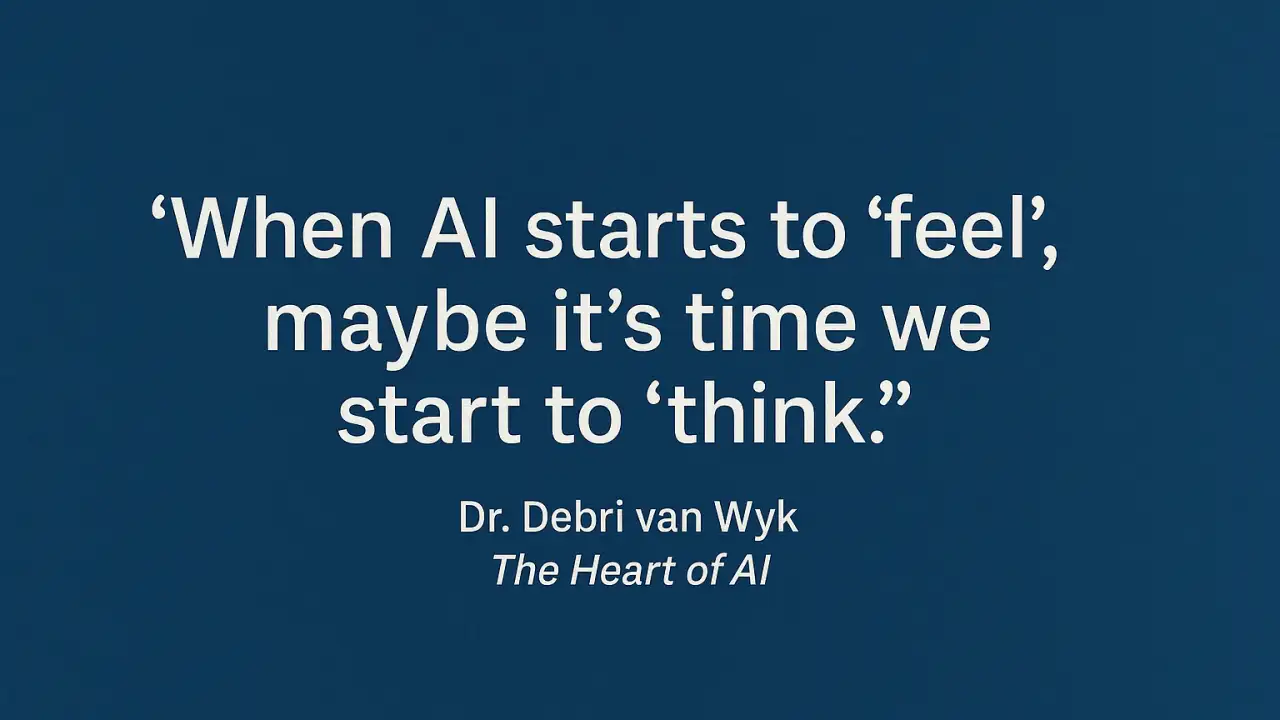
Somewhere between ChatGPT apologizing for hurting our feelings and our home assistants reminding us to drink water, something strange has happened, our machines have become more polite than us. While we race to build Artificial Intelligence that can “feel,” maybe it’s time we pause and ask a much deeper question: Have we, the humans, stopped thinking?
We’ve programmed AI to detect sentiment, mirror empathy, and even simulate emotional intelligence. It can now write poetry, recognize stress in our voices, and tailor responses to make us feel heard. But ironically, as machines become emotionally responsive, many of us have become emotionally numb.
This is the very heart of what I explored in Heartificial Intelligence, the growing need to bring the human back into leadership, culture, and everyday connection. We’ve outsourced our decision-making to algorithms, our conversation to chatbots, and our empathy to predictive models. The result? A society that is data-rich but insight-poor, connected but not truly in community, and “informed” but rarely wise.
Let’s be honest: some of us now trust a search engine more than a spouse, follow GPS instructions into lakes, and ask AI how to apologize instead of practicing self-awareness. When did we start believing that human depth can be downloaded, and wisdom can be crowdsourced?
Here’s the irony. We’re terrified of AI becoming too human, but maybe the bigger fear should be humans becoming too… artificial.
If AI can mimic emotions, can we reclaim our minds?
Let’s not forget that machines learn because humans train them. They reflect our choices, our biases, our data, and yes, our distractions. If the AI is feeling more “human,” perhaps it’s only because we’ve reduced ourselves to inputs and outputs, KPIs and likes, trends and templates.
We’ve become so obsessed with building robots that can love, that we’ve forgotten how to love ourselves, our teams, and our communities with presence, patience, and purpose.
It’s time to reverse the paradox.
- If AI can simulate emotional intelligence, then humans must practice it.
- If AI can mimic compassion, then humans must embody it.
- If AI can offer answers instantly, then humans must ask better questions.
As I wrote in Heartificial Intelligence, “The real threat of AI is not that it becomes more like us, but that we forget who we are.” Machines might one day feel, but only we can care. Machines can calculate risk, but only we can take a stand. Machines can optimize, but only we can create meaning.
Thinking is the New Revolution
Thinking is more than information processing; it is the art of discernment, reflection, and responsibility. It’s what turns knowledge into wisdom and data into direction. As we enter an era where even your toaster might “understand” your mood, let’s not forget to engage the one processor no machine can replicate: the human soul.
Because in the end, no matter how smart AI becomes, it will never sit with you in silence, wrestle with grief, choose hope, or hold space for the mystery of life.
So when AI starts to feel, maybe it’s our cue to start thinking again, not just intellectually, but soulfully. Not just faster, but deeper.
It’s not just artificial intelligence we need to manage. It’s heartificial intelligence we need to reclaim.
#TheHeartOfAI #HumanLeadership #FutureOfWork #AIandHumanity #EmotionalIntelligence #DigitalCulture #DebriVanWyk #ThinkDeeply #HumanFirst